
Introduction
Several purchase options are offered by modern procurement platforms to assist customers in effectively acquiring goods and services. Buyers can select several procurement strategies based on the urgency, complexity, budget, and procurement goals.
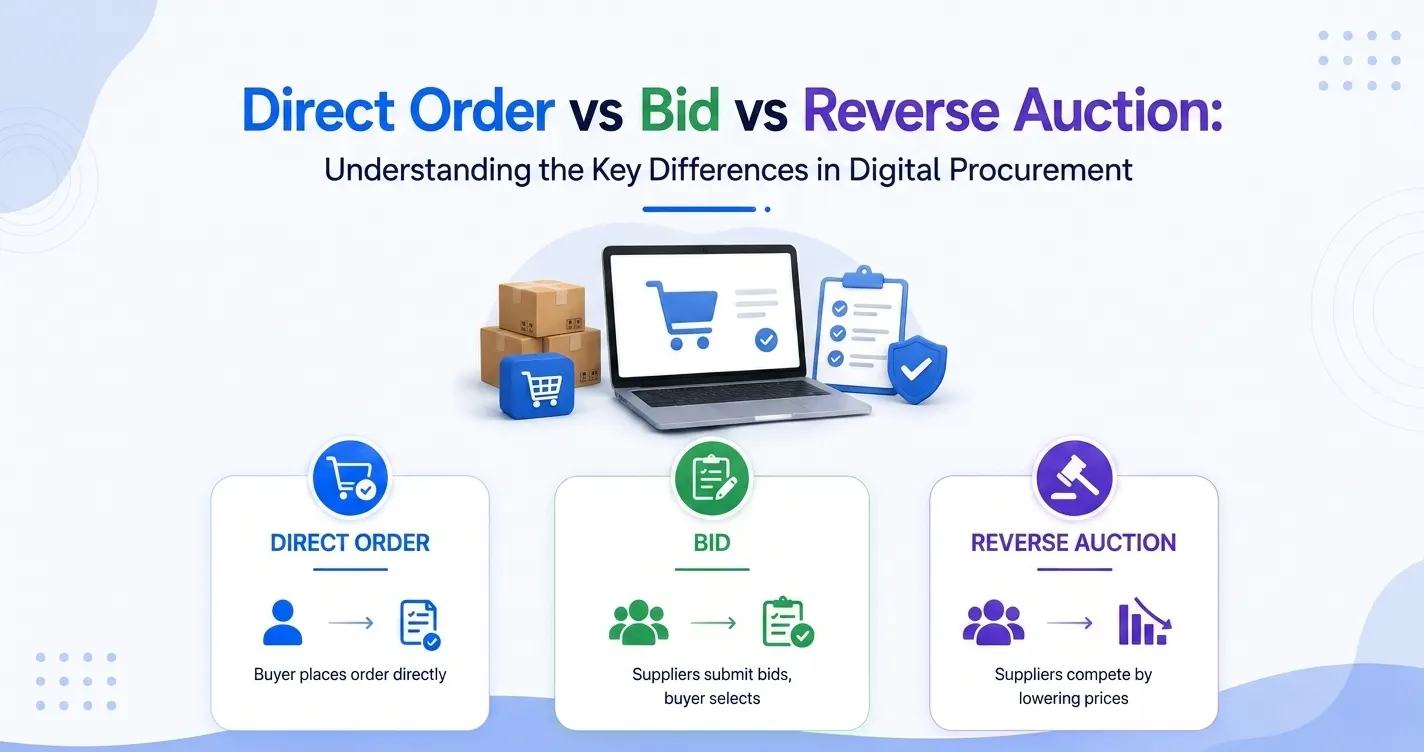
Direct Order, Bid Tender, and Reverse Auction (RA) are three of the most used procurement techniques. Each approach has a distinct function and provides buyers and sellers with special benefits.
Organizations can improve procurement outcomes and make well-informed purchase decisions by being aware of the distinctions between these strategies.
What is a Direct Order?
The quickest and most straightforward way of purchase is a direct order. In this method, a buyer buys a good or service straight from a seller without going through an auction or bidding procedure.
The buyer reviews product details, pricing, and specifications before placing an order.
How Direct Order Works
Buyer searches for a product.
Buyer selects a suitable product.
Buyer reviews product specifications and pricing.
Buyer places the order directly.
Seller fulfills the order.
Best Suited For
Advantages of Direct Order
Quicker procurement procedure
Quick decisions about purchases
Decreased administrative work
Easy to make frequent purchases
What is a Bid?
A Bid is a competitive procurement process where a buyer publishes a requirement and multiple sellers submit their offers.
Before choosing a supplier, the buyer assesses the submitted bids according to cost, technical specifications, experience, quality, and other procurement criteria.
How Bid Tender Works
Buyer creates a tender.
Sellers submit bids.
Buyer evaluates all proposals.
Buyer selects the most suitable bidder.
Order or contract is awarded.
Best Suited For
Advantages of Bid
Competitive supplier participation
Increased openness
Greater choice of suppliers
Assessment based on several factors
What is a Reverse Auction (RA)?
In a reverse auction, sellers compete by consistently lowering their prices throughout a predetermined bidding period.
Reverse auctions encourage suppliers to offer lower pricing in order to win the procurement opportunity, as contrast to typical auctions where buyers compete by raising their bids.
How Reverse Auction Works
Buyer creates a Reverse Auction.
Qualified sellers participate.
Sellers submit and revise prices.
Competition drives prices downward.
L1 seller price is selected.
Best Suited For
Advantages of Reverse Auction
Competitive pricing
Cost optimization
Transparent bidding process
Faster price discovery
When Should Buyers Choose Direct Order?
Direct Order is ideal when:
When Should Buyers Choose a Bid ?
Bid are ideal when:
When Should Buyers Choose a Reverse Auction?
Reverse Auctions are ideal when:
How Private E-Marketplace Supports All Three Procurement Methods
Private E-Marketplace provides buyers with the flexibility to choose the procurement method that best matches their requirements.
Through Private E-Marketplace, verified buyers can:
Conclusion
Three effective procurement strategies that meet various corporate requirements are Direct order, Bid, and Reverse Auction.
Bids allow for thorough seller evaluation, Direct Orders provide speed and convenience, and Reverse Auctions facilitate competitive pricing through seller competition.
Businesses may choose the best strategy for their purchasing needs and increase overall procurement efficiency by knowing the advantages of each procurement method.